
What Is MODOC?
MODOC is the Missouri Department of Corrections. The abbreviation is confirmed by the agency's own website, which uses "About MODOC" and links to "MODOC Home" from the Offender Search page. MODOC is the statewide corrections agency for Missouri state prison custody, probation, parole, conditional release, transition centers, community supervision centers, and related field services. It is not a county sheriff's office and does not run a statewide roster for every recent jail arrest.
The distinction is basic but critical. A person booked this morning by a sheriff may be listed only on the county jail roster. A person sentenced to state prison, released to parole, assigned to probation, or supervised by MODOC belongs in the MODOC inmate population or active offender search universe. The agency states that about 96 percent of people who enter prison return to Missouri communities, which is why the MODOC inmate population connects state prisons back to county-level reentry and supervision.
The Missouri Department of Corrections website confirms the MODOC branding and provides statewide navigation for offender search, facilities, family resources, victims, and public information.
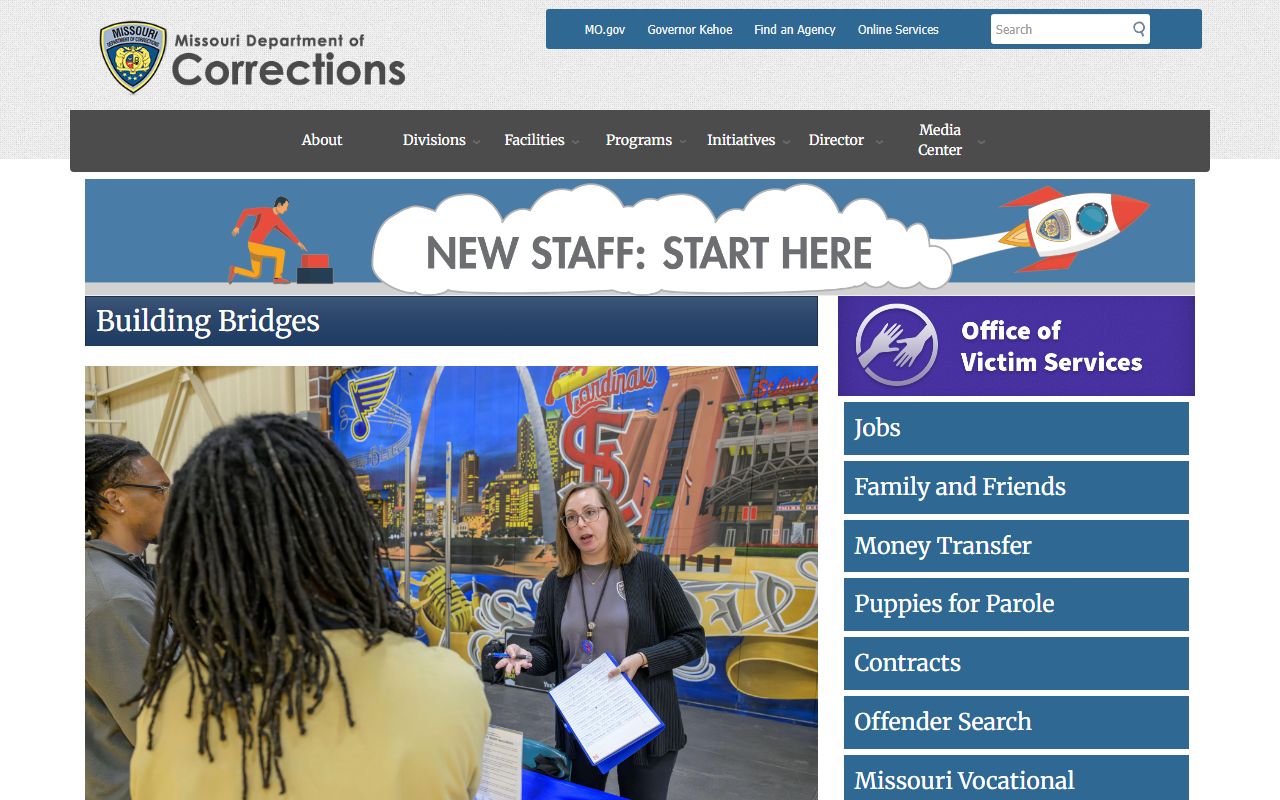
The agency home page is the right starting point for state-prison and supervision context before using the narrower offender search.
The MODOC Inmate Population
The official FY25 profile reports 24,454 institutional offenders on June 30, 2025. That is the core MODOC inmate population in prison custody. The total included 22,342 male offenders and 2,112 female offenders. Race and ethnicity were reported as 15,360 White offenders, 8,205 Black offenders, 676 Hispanic offenders, 110 Native American offenders, 49 Asian offenders, and 54 unknown. The profile also reports average sentence length and offense-group totals.
By most serious offense group, the prison count included 10,829 violent offenses, 4,608 sex or child-abuse offenses, 5,114 nonviolent offenses, 3,455 drug offenses, and 448 DWI offenses. The total average sentence was 14.2 years. Male offenders averaged 14.6 years and female offenders averaged 10.5 years. These numbers are not a release-date calculator. They describe the population as a whole.
| Measure | Figure | Source / Date |
|---|---|---|
| MODOC inmate population in institutions | 24,454 | FY25 offender profile, June 30, 2025 |
| Male institutional offenders | 22,342 | FY25 offender profile, June 30, 2025 |
| Female institutional offenders | 2,112 | FY25 offender profile, June 30, 2025 |
| Correctional centers stated by MODOC | 21 | MODOC facilities page |
The MODOC publications page links the offender profile used for these prison-population figures.
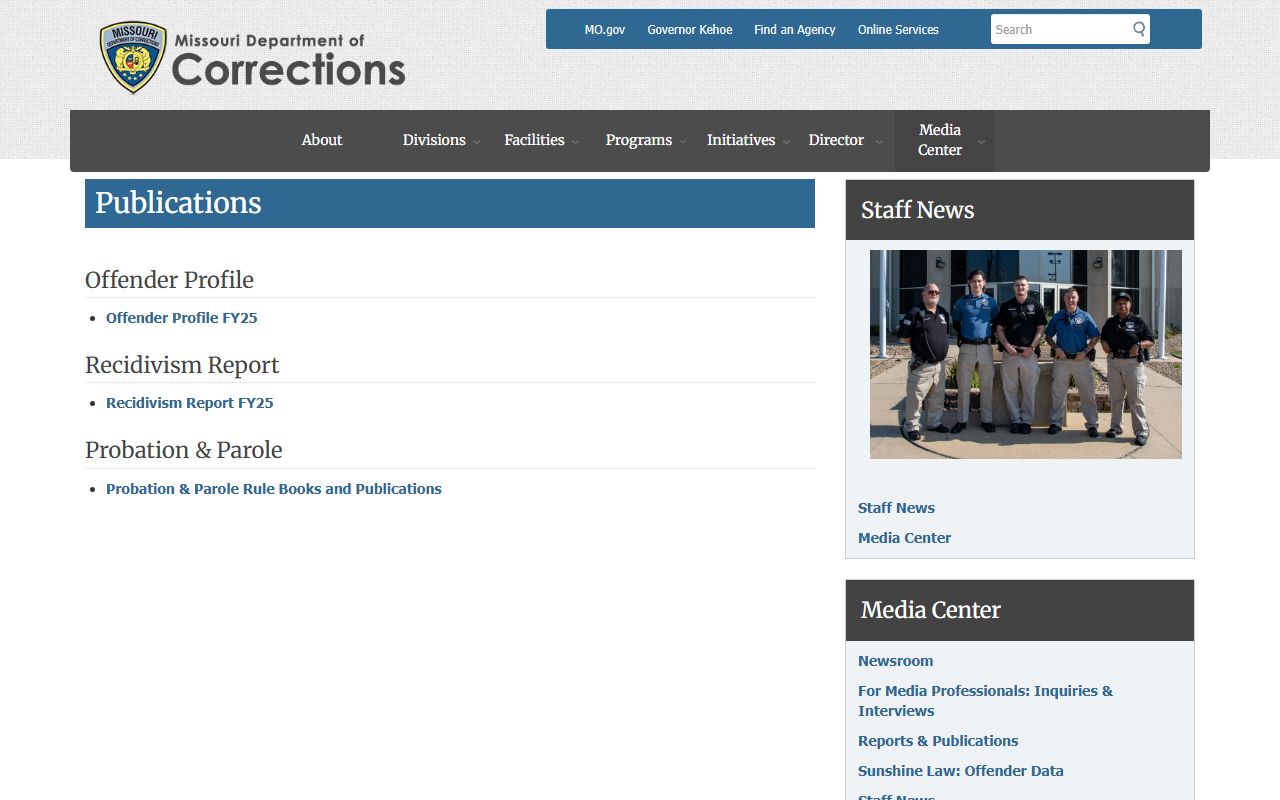
Population figures on the MODOC inmate population page should stay tied to the publication year and report source.
How to Search the MODOC Inmate Locator
The official search tool is the Missouri Department of Corrections Offender Search at web.mo.gov/doc/offSearchWeb. During research, the page stated that offender data was current as of July 5, 2026 at 9:00 PM. It searches active offenders supervised by MODOC, including probationers and parolees, unless a record is excluded from public display. It searches first and last names, including aliases. It does not provide discharged-offender information.
- Open the official MODOC Offender Search and read the data-current timestamp.
- Complete the captcha before submitting the search.
- Search by first and last name, and try known aliases or spelling variations.
- Treat a result as a MODOC custody or supervision lead, not as proof of county jail custody.
- For status questions, use the institutional caseworker, Probation and Parole field officer, Constituent Services, or Victim Services path named by MODOC.
The MODOC Offender Search page shows the active-offender scope, captcha, data timestamp, and exclusions.
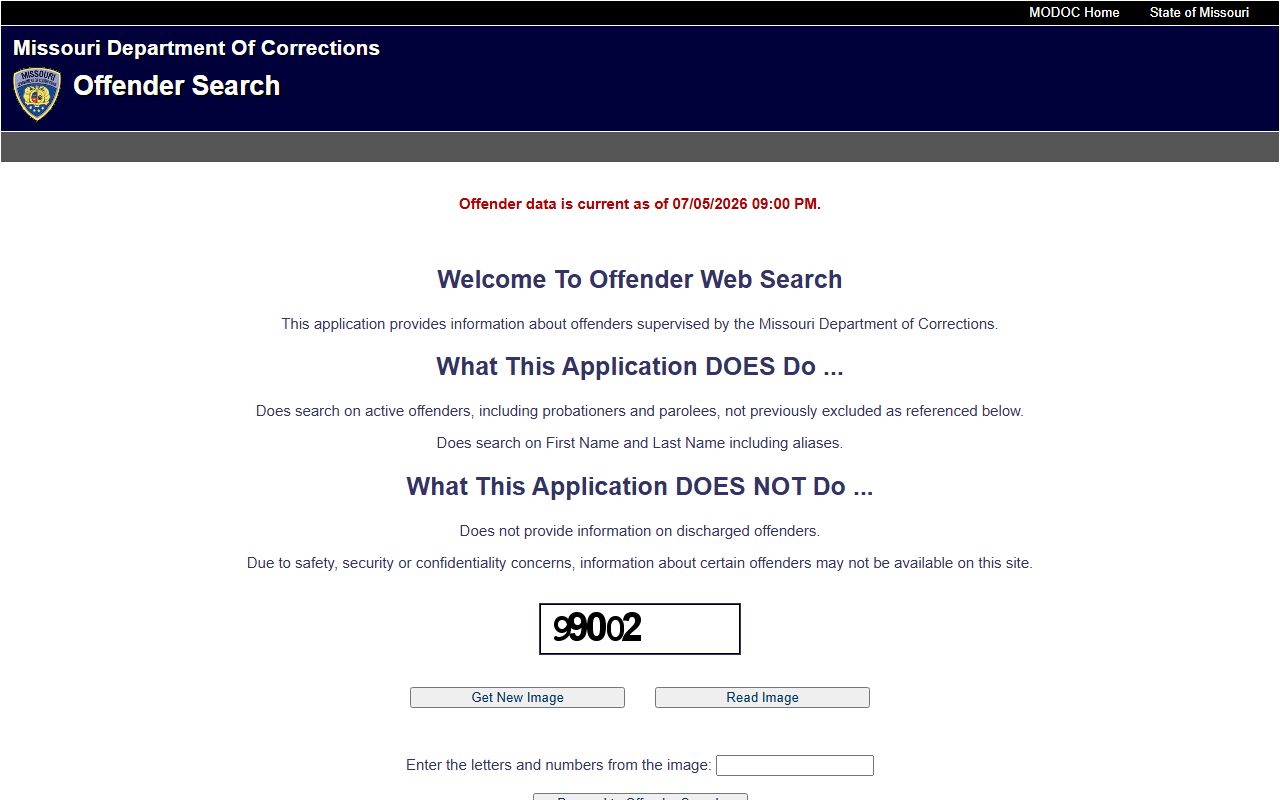
The active-offender scope explains why a person can be missing from MODOC even though a county jail or court record exists.
What a MODOC Inmate Record Shows
A public MODOC record can show state supervision or custody clues, but the research warns against overreading it. The search covers active offenders, including probationers and parolees. Some people may be excluded for safety, security, or confidentiality reasons. Discharged offenders do not appear in the live search. The Sunshine Law offender data file is broader, but it may not reflect current information and much of its information is based on offender self-reporting.
| Field or clue | What it means |
|---|---|
| Name and aliases | The person searched by first and last name, with aliases included in matching. |
| Active status | The person is under MODOC supervision unless excluded from public display. |
| Facility or office | A state prison, transition center, or supervision context rather than county jail custody. |
| Offense or charge data | A state record field that should be checked against sentence documents and Case.net. |
| Release or supervision clue | A public lead that may require the caseworker or parole office for person-specific questions. |
MODOC Prisons and Facilities
MODOC says it manages 21 correctional centers, with 19 for men and two for women. The adult-institution address listing visible during research listed 19 rows with acronyms, names, security levels, locations, addresses, and phone numbers. The page should not invent missing facility names to force the count to match. It can say MODOC states the 21-center count and then use the official listing for the named institutions shown.
Security levels are listed as level 1 minimum, level 2 medium, and level 5 maximum. Missouri has reception and diagnostic centers, treatment centers, minimum security centers, medium security facilities, maximum security facilities, transition centers, and community supervision centers. State prison records and visitation rules belong to MODOC, while local jail visitation and roster rules belong to the county or city facility.
| Institution type | Examples from the research | Search route |
|---|---|---|
| Correctional center | Algoa, Boonville, Jefferson City, Moberly, Potosi | MODOC Offender Search |
| Reception or diagnostic center | Eastern, Fulton, Western, Women's Eastern | MODOC Offender Search |
| Transition center | Kansas City and St. Louis entries | MODOC or supervision office routing |
| County jail | Local detention centers across Missouri | County jail roster through the directory |
The MODOC adult institution listing gives acronyms, names, security levels, addresses, and phones for listed adult institutions.
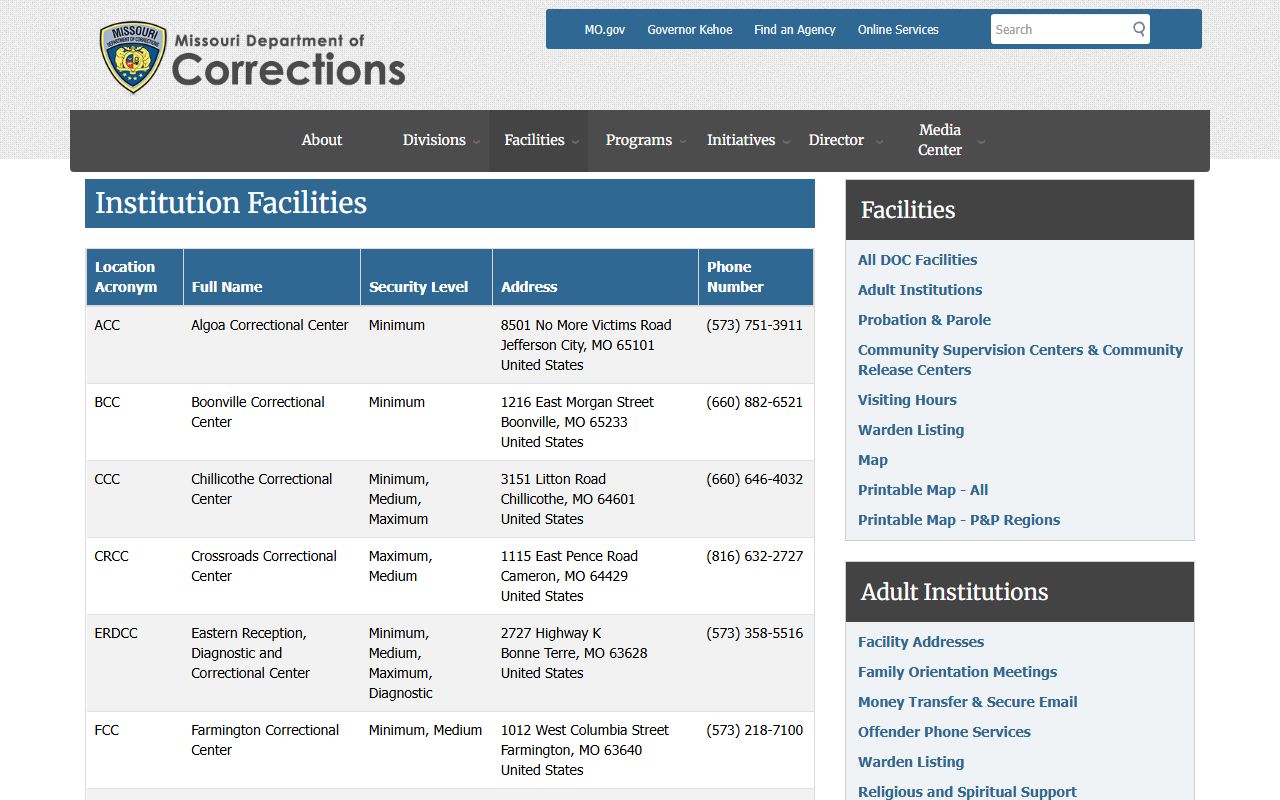
Those rows support facility-level routing without treating state prisons as county sheriff jail rosters.
MODOC Inmate Population Trends
The MODOC inmate population increased from 24,010 in FY2020 to 24,454 in FY2025, a 1.8 percent increase over five years. The change was not uniform. Female population rose 3.1 percent, male population rose 1.7 percent, nonviolent offenses rose 17.2 percent, violent offenses rose 0.9 percent, sex and child-abuse offenses fell 2.2 percent, drug offenses fell 6.6 percent, and DWI fell 11.5 percent.
Those trends show why a single headline count is not enough. A person-level MODOC inmate search tells where an active offender appears in the state system. A population report tells how the state-prison count and offense mix changed over time. Neither source alone tells whether a person is in a county jail today, whether a court charge is pending, or whether a release date has changed after a board decision.
| Trend | Reported change | Source |
|---|---|---|
| Total institutional population | 24,010 to 24,454 | FY2020 to FY2025 comparison |
| Female population | 3.1% increase | MODOC FY25 profile |
| Male population | 1.7% increase | MODOC FY25 profile |
| Drug offense group | 6.6% decrease | MODOC FY25 profile |
MODOC Sentencing and Release
Missouri release eligibility is case-specific. The research points to parole-board authority in RSMo 217.690, imprisonment and conditional-release terms in RSMo 558.011, minimum prison terms in RSMo 558.019, and time-credit references in RSMo 558.041. Those statutes should be described as framework, not a formula for one person's date.
MODOC's early discharge and earned compliance credit page explains that early discharge is final release from probation, parole, or conditional release before the scheduled expiration. The sentencing court can reduce a probation term it set, the Parole Board can authorize early discharge from parole or conditional release, and Probation and Parole can discharge an offender early based on earned compliance credits where eligibility and compliance allow it.
The MODOC earned compliance credit page explains early discharge routes for supervision cases.
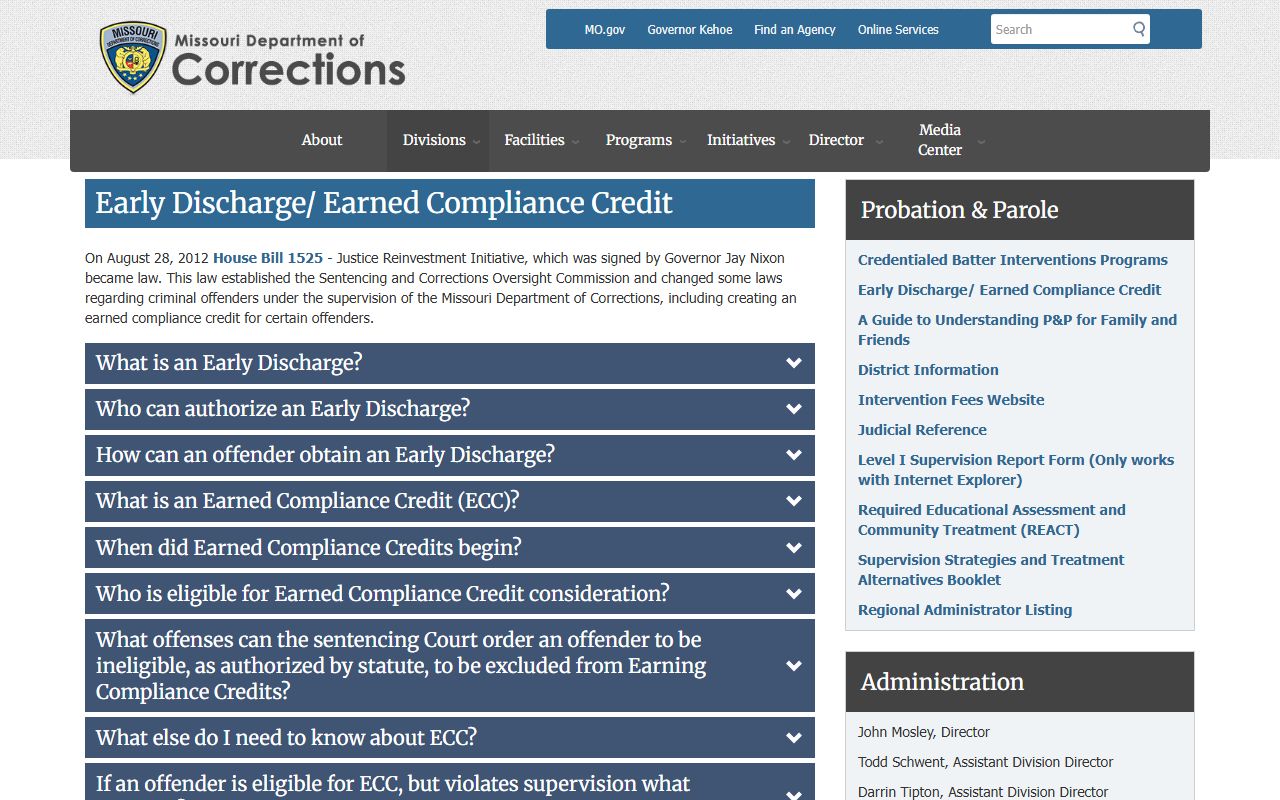
That page is useful for supervision context, but it does not replace person-specific parole, caseworker, or court information.
MODOC Parole Board Routing
The Missouri Parole Board page lists DOC.COBoardOperations@doc.mo.gov for correspondence, links the Blue Book, and states that time-to-serve guidelines in appendices do not guarantee release. The Board reserves discretion to give a release date below or above the guideline. Questions about specific release dates and home plans are routed to the institutional parole office where the offender resides. Questions about conduct violations go to the Division of Adult Institutions.
The Missouri Parole Board page is the official source for board routing, Blue Book access, and release-date cautions.
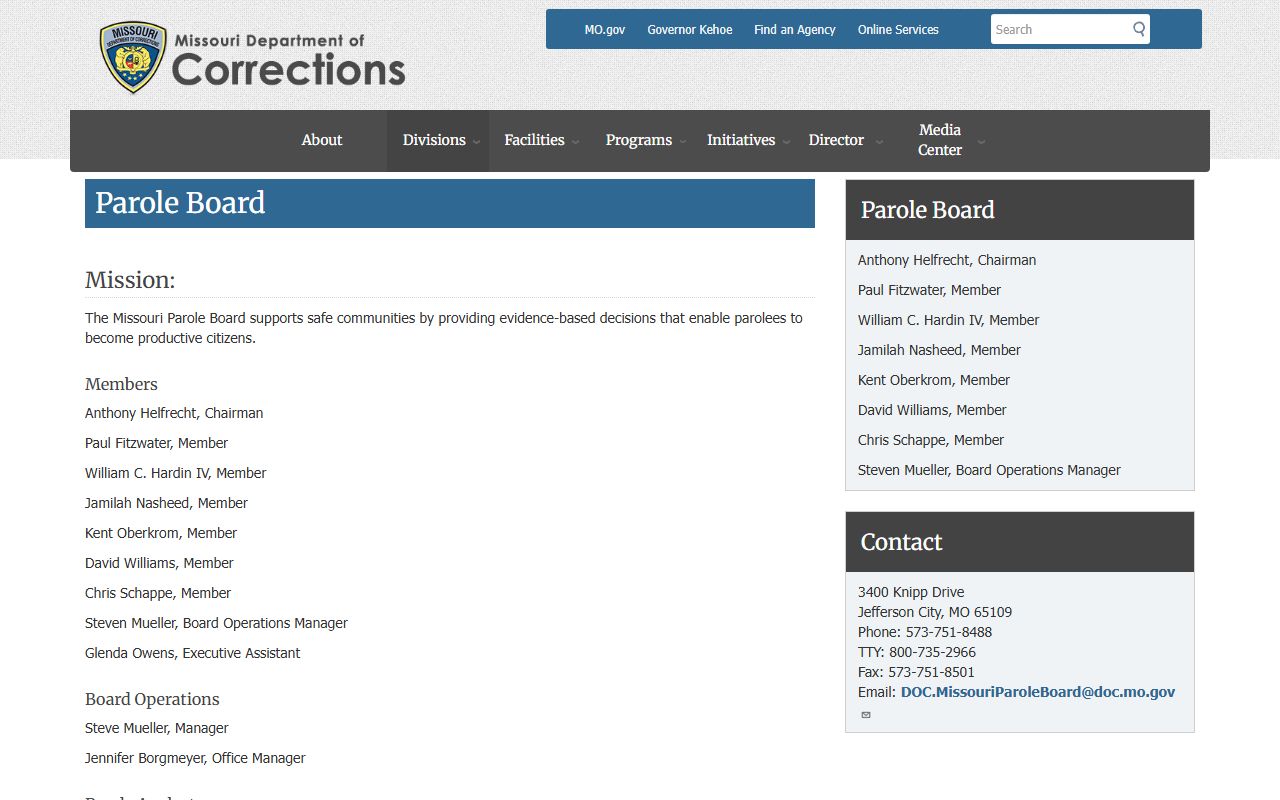
The Parole Board source keeps release discussion conservative and avoids promising a date from public search results alone.
MODOC Inmate Records Requests
MODOC has a specific Sunshine Law page for records requests and offender data. Requests go to the appropriate custodian for the division involved. The research names Office of Director requests at OD.SunshineRequest@doc.mo.gov and Missouri Parole Board requests at ParoleBoard.SunshineRequest@doc.mo.gov. The page also describes a compressed offender data file updated nightly, with field layout documentation and warnings about currency and self-reported information.
Use MODOC for state prison, supervision, parole-board, and agency-held offender records. Use the sheriff, jail, police department, or county custodian for county booking sheets, arrest reports, jail logs, and local records. Use Case.net or the circuit clerk for court documents. Missouri's Attorney General guidance says the request should go to the public body that created or maintains the record.
The MODOC Sunshine Law page gives custodian emails and offender data file information.
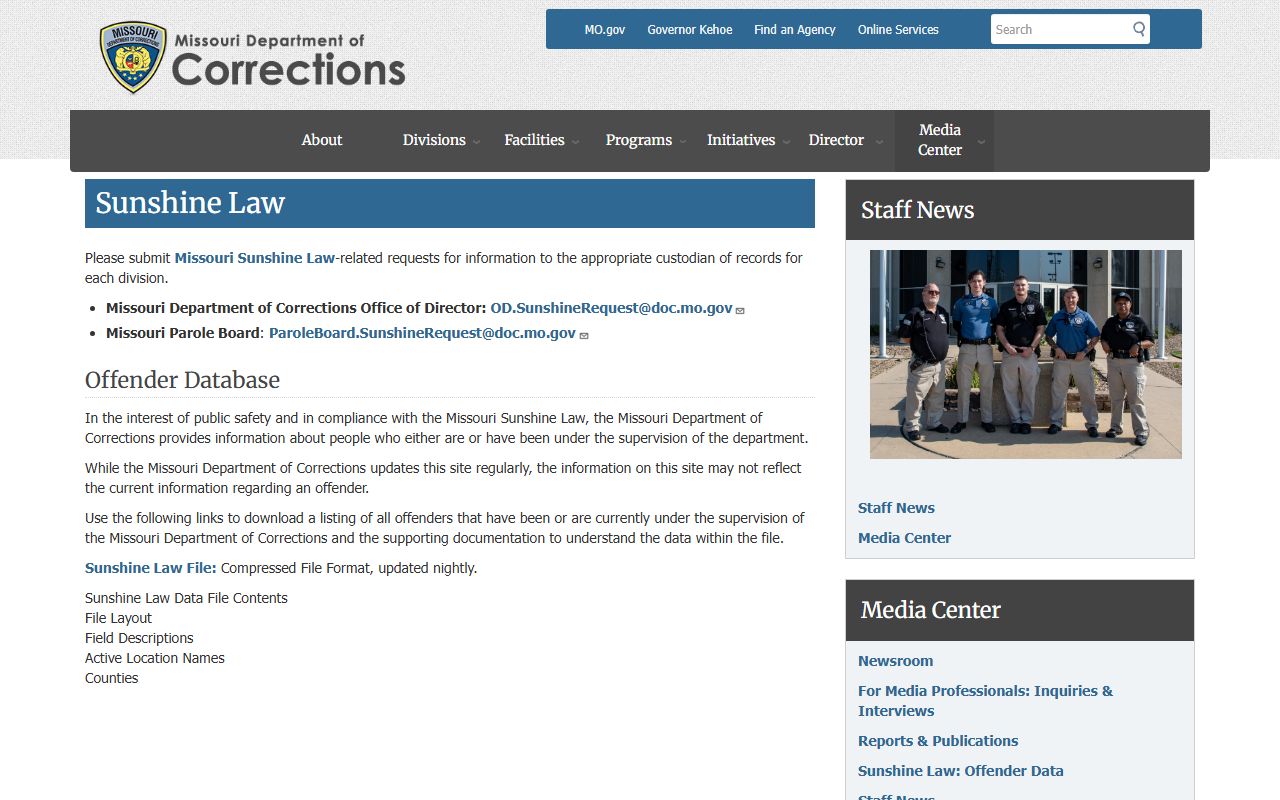
The MODOC records channel is separate from county jail records requests and should be used only for records MODOC maintains.
MODOC vs Missouri Jail Search
A MODOC inmate population search should be used for Missouri Department of Corrections custody or supervision. A county jail search should be used for local booking and pretrial custody. A federal search should be used for BOP custody, including the federal medical center in Springfield. ICE ODLS should be used for immigration detention. Court records after a jail arrest should be checked in Case.net or with the circuit clerk.
| Question | Best source | Reason |
|---|---|---|
| Serving a Missouri state prison sentence? | MODOC Offender Search | MODOC runs state prison custody. |
| Booked into jail after arrest? | County jail roster | County sheriffs run local jail records. |
| Formal charges after arrest? | Case.net or circuit clerk | Court records are separate from jail rosters. |
| Federal inmate? | BOP inmate locator | Federal custody is outside MODOC. |
For local booking searches, use the Missouri county directory. For all listed custody facilities, use the Missouri facility directory.
MODOC Inmate Population FAQ
What is the current MODOC inmate population?
The official FY25 profile reports 24,454 institutional offenders on June 30, 2025. That figure covers MODOC institutional custody, not every county jail booking in Missouri.
Does MODOC Offender Search include parolees?
The research says the search covers active offenders supervised by MODOC, including probationers and parolees, unless a person is excluded from public display. It does not show discharged offenders.
Can MODOC calculate a release date from the public locator?
No public page should calculate an individual's release date. Missouri release depends on statutes, sentence documents, parole-board decisions, credits, conduct, program rules, and later court or board action.